

I have a confession.
The older I get, the less interested I become in blaming children for acting like children.
Instead, I find myself wondering what role the adults played and how much of that responsibility they are willing to take
.
A few weeks ago, I dabbled in the tepid waters of questioning whether or not I think Brené Brown is wrong in her take on shame. I wondered if we may have misunderstood what shame is and what it does, and whether our culture’s desire to eliminate it entirely has created consequences we did not anticipate.
You can read the first post here in the second post here.
As I stated in those posts, the idea came from Neil Postman’s seminal work, The Disappearance of Childhood.
In that book he argues that childhood disappears in four stages.
First, literacy disappears. The ability to read and comprehend is a foundational separation from childhood to adulthood. When I was a child, I remember my parents spelling words that I could not spell to keep me in childhood when they were discussing adult things. As my ability to spell increased, they began spelling words backwards.
Secondly, education goes away. Education is the organized method by which we shepherd our children into adulthood. It is the process by which we take a child and help them enter into the largest stage of their life, adulthood. Perhaps another day we should discuss our society’s disdain for adulthood.
Thirdly, he argues that the loss of shame will follow those losses. His argument is that shame is what separates childhood from adulthood. The idea is that we should have knowledge, language, and actions that is reserved for adults. Allowing children to engage in that adult knowledge, language, or actions should produce some level of shame. It was this section that gave me some language to consider my revisions about Dr. Brown’s work.
Fourthly, he argues the childhood itself is lost when these three things are not part of it. In those first two post, I talked about the consequences of that. In fact, I posited that he might consider changing the title of his book to the disappearance of adulthood. When childhood is gone, adulthood usually led the way.
The idea that we have lost adulthood in modern society is difficult to ignore. I was just talking to someone yesterday who’s 30 year-old son still lives in their basement. And I know there are many people who are willing to come for me with many reasons why adulthood has been vilified and removed from society. That’s fine. That will all be fought for another post.
Whether Postman was completely right or not, is a worthy discussion. What I think is interesting about this book is that there is something there for everyone to like and almost everyone to probably dislike. He rightly called out the dangers of our ability to communicate faster than we could travel.
He pointed out the dangers of consuming information via TV. He correctly states that no matter how much time you spend watching TV it’s not a skill like reading. He called for society to come back to more reading.
Unfortunately, he also gave himself an out where he stated he doesn’t know the solution to the problems he sees.
On the last page of the book, he talks about parenting as an active rebellion against American culture. He gives simple steps that people can engage in to help their children become fully formed adults.
He talks about, insisting that your children learned the practice of delayed gratification. But let’s be honest, most parents don’t practice that skill. Most of my work as a counselor when it involves wayward children is rooted in parents who lack the skills they’re trying to instill in their children.
My favorite part is when he talks about critiquing the information that your children are ingesting. In other words, engage with your children in everything they are learning. But this goes against the very world that we have created Dr. Postman when he was in his career, was actually a teacher. In other words, he was one of those people, that we have decided to outsource our child’s learning to.
And there can be good reasons for that. But I can’t help, but wonder if maybe part of the reason childhood is disappearing is because we have outsourced much of literacy education in the withholding of knowledge to other people.
Have we lost the plot in how we educate our children?
And I don’t mean just at school.
We expect the youth pastor to teach them the Bible. We expect the school to teach them basic life skills like cooking, changing the oil in our car, etc..
We’ve decided to dress them like adults.
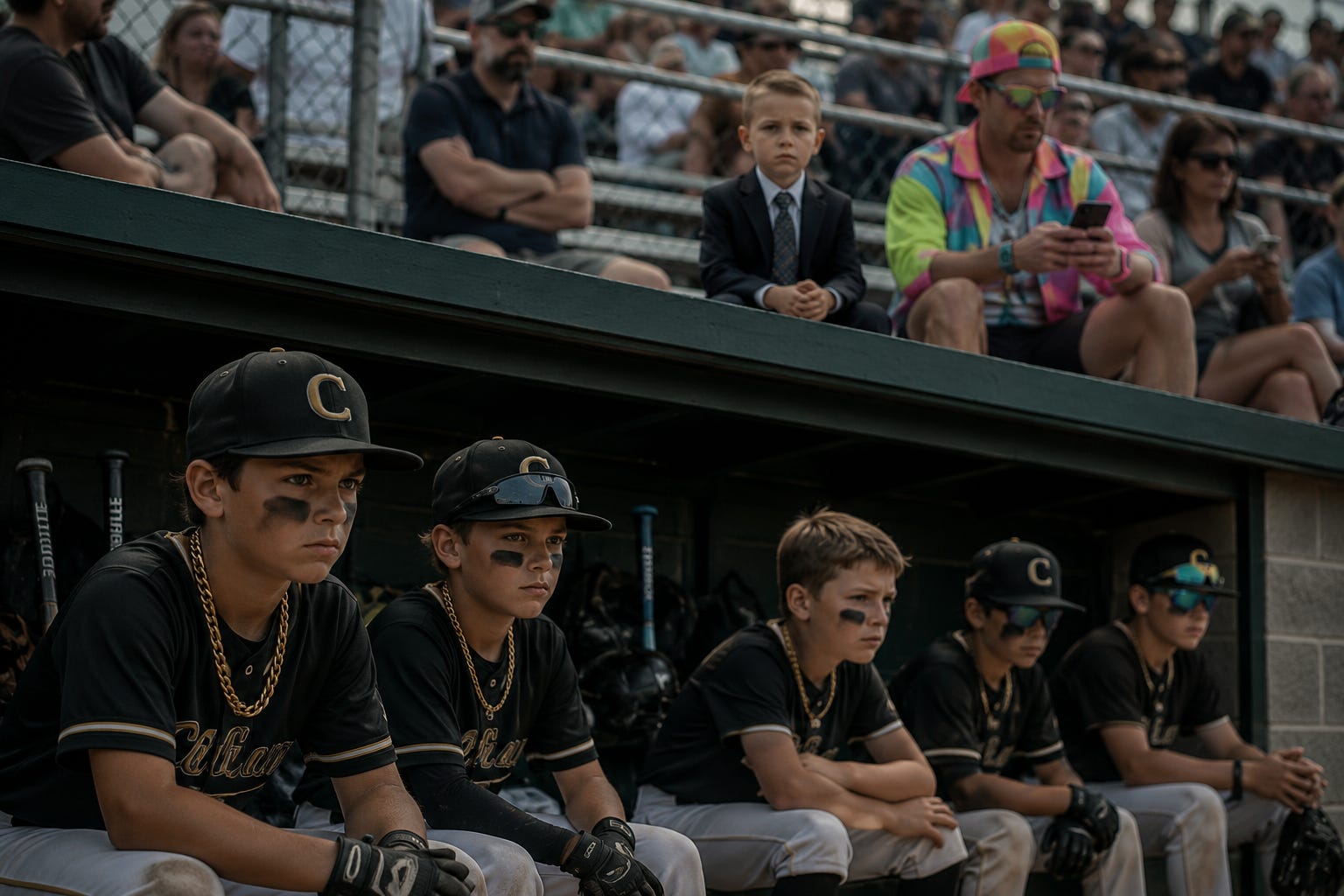
We want them to play like adults. Don’t believe me? Go to any local youth baseball game this weekend. Look at all of the “drip” that each player has. I have a friend who had to remove his kid from a youth baseball team because after paying $6000 for the child to play on the team, a number that does not include all of the child’s equipment, he was expected to come up with another $2000 so that the team could have a professional batting coach.
His child is 11.
And that’s before we get to technology. You know, I am not anti-technology. I think technologies is one of humanity’s greatest achievements. The problem is that we often mistake to information for understanding.
Worse, we try to pretend that knowledge has no responsibilities.
I think this is the part that most rattles in my brain.
We have become so obsessed with kids feelings that we have stopped truly training them in anything but reacting to their feelings. We’ve stopped training them what to do when they experience those feelings and ignored the uncomfortable truth that much of what we have taught them is not helping them become healthy.
We have tried to pretend that there is no objective standard except feelings, which is a contradictory idea, at best.
And the results speak for themselves.
According to NCES and the OECD’s 2023 Program for the International Assessment of Adult Competencies (PIAAC):
· 21% of U.S. adults (roughly 43 million people) struggle with literacy tasks beyond a basic level.
· Only 44% of American adults scored at the highest literacy proficiency levels (Level 3 or above) in the 2023 assessment.
· The percentage of low-performing adults increased from 29% in 2017 to 34% in 2023.
· U.S. literacy scores declined between 2017 and 2023.
· Reading proficiency among American eighth graders reached its lowest level since federal tracking began in 1992.
· More than 30% of high school seniors lack basic reading skills.
I can’t help but look at that information and wonder, “what if Postman is right? What are the implications for our society?”
Is this why we are seeing the mixing of adulthood and childhood resulting in a net loss to both?
If literacy, and education are gone, and we’re working hard to get rid of shame what does that mean for those who will follow us?
Every generation worries about children.
Fewer generations are willing to ask what the adults are doing wrong.
Children do not accidentally become adults. They are led there. Literacy leads them there.
Education leads them there. Boundaries lead them there.
Responsibility leads them there.
When those things disappear, childhood does not become stronger. It evaporates like a morning mist.
The question I keep coming back to is not whether children are changing.
Children have always changed.
The question is whether the adults in the room are still willing to do the work of helping them become adults. Are we willing to stand up to the potential slavery of our feelings?
Because if we are not, then perhaps the real disappearance is not childhood at all.
Perhaps it is adulthood.
Subscribe here.