
Last week I talked about shame and Brené Brown. I also talked about Neil Postman and how I think he is one of the most underappreciated thinkers of the last century. Perhaps the most controversial thing I said was that I thought Brené Brown might be wrong when it comes to shame.
More than a few people reached out to me personally and asked me what I meant by that sentence. In part, because I was the one who introduced them to her and her Ted talk, which can be found here. I have loudly and proudly lauded many of her assertions in her work. Many of my clients have found real and lasting change that began with questions that she brought up and statements that she made.
I want to come back to Postman’s book, The Disappearance of Childhood, which could be more aptly titled, “The Disappearance of Adulthood.” But that Post needs to wait another week.
This week, I want to talk more about shame and how we interact with it in society.
In her Ted Talk listed above (which has a lot of amazing information) she states some excellent things such as:
- Vulnerability is not weakness. I agree with her and believe this message needs to be proclaimed loudly for all to hear.
- To create is to make something that has never existed before and that is intensely vulnerable. Agree again.
- We have to talk about shame and no one wants to talk about it. I also agree with this. We do need to talk about shame and very few people are willing to do that. Dr. Brown has been rightly credited with being perhaps the first person to bring the conversation to the public.
- She quotes my favorite Teddy Roosevelt quote. The Man in the Arena. Find it here.
- The critic in our head is mostly us. This is so true. Most of the time, we are our greatest roadblock.
- She correctly shows us how much what she calls shame (I’d call it something else) is correlated with bad outcomes such as addiction, and other life difficulties. The research on this is robust and extensive.
- She tells that we all feel some shame and those who don’t are probably sociopaths. Research would support this idea.
So what’s the problem? Especially if you read my first book, The Emotionally Secure Couple, you know that I devote an entire chapter to the reality that relationships fall apart when they are run by guilt, fear and shame, so what’s the problem.
Words Matter.
Well, words matter. A lot.
They shape how we communicate and how we communicate shapes how we form our beliefs, our actions and ultimately our way of being.
In her TED talk she gives examples of shame that are our inner voice reminding us about what other people have done to us (the other person part is important).
She gives us examples like:
“I know those things that happened you growing up.”
“I know you don’t think you’re pretty enough or smart enough or talented enough or powerful enough.”
“I know your dad never paid attention even when you made CFO.”
She then tells us, “Even if we can quiet it down and walk in and tell it, ‘I’m going to do this.’ We look up and the critic we see pointing is laughing is who? Us!”
She further tells us that shame drives too big tapes, “Never good enough and who do you think you are?”
Then she makes a concerted effort to teach us that shame is not guilt. She says, “Shame is a focus on self, guilt is a focus on behavior.
Shame is ‘I am bad.’
Guilt is ‘I did something bad.’”
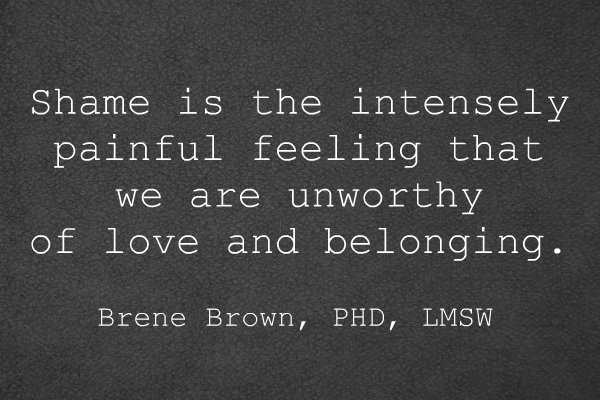
She is credited with the definition of shame as “Shame is the intensely painful feeling that we are unworthy of love and belonging.”
But!
And this is a serious question that I have. Is that really the definition of shame? I can’t find it in any dictionary.
In two dictionaries I found statements or third definitions that stated something to the effect of pervasive shame can lead to feelings of worthlessness, etc.
In other words, she gives us a brand new definition of shame. In order to help us, she massages the definition of word and gives us something to understand that can help us.
In her effort to help, she has succeeded.
Many people have listened to this TED talk with it’s millions of views and found something powerful in it.
In an attempt at full transparency, I’ve done something similar with my clients. I have told clients that stress happens to us, anxiety is how I respond to it. This separates the two words and is more faithful to my own theoretical orientation. In other words, someone screaming at me is stressful, but I get to choose if I engage in anxiety.
For psychology nerds, this is a fairly straightforward use of Rational Emotive Behavior Therapy (REBT).
So why worry about Dr. Brown who has more formal education than I do shifting a word a bit.
This is where I wrestle with the question of do I disagree with her or what we’ve done with her work?
What Came Next?
This talk came out 14 years ago. That’s an eternity in our modern world. Which is why I think it deserves our attention today. Fourteen years is long enough for us to see both the intended consquences of her helping people and the unintended consequences of what that shift in terminology might have cost us. And how much deeper that cost might go if we don’t address it.
We treat shame like a weapon in our society today.
Just the other day, I watched a video where a woman videotaped a man “following her” on a walking trail. She actually said, “Shame! Shame! Shame on you!” He responded colorfully asking her where he was supposed to walk on the walking trail.
I have heard countless people respond to be being disagreed with or criticized with, “Don’t shame me!”
I’ve sat in my therapy room and had people tell me their spouse was shaming them when in reality the spouse was disagreeing with them.
We’ve vilified shame. We’ve taken our own self agency and abdicated it to others. If you say something I don’t like about me or what I did you are shaming me. Therefore in order to protect my mental health, I need to disengage from you either by avoiding you or shouting you down.
Shouting the other person down is our modern day mini cancel culture.
If I were to be having this discussion with Dr. Brown (who has never been a Therapist), I’d ask her why? Why is shame focused on self and guilt on behavior?
Because that’s new.
For most of our usage of the word shame, it’s been about behaviors and let’s be honest, that’s a good thing.
There are some things, maybe many behaviors we should feel shame.
Here’s my biggest struggle with her work, she equates shame with identity.
Feeling shame and feeling like you are unworthy are not the same thing.
What Dr. Brown defines as shame is actually an inaccurate understanding of self. It could be labeled self-loathing or inaccurate self-view.
We could just call it a bad understanding of identity and worth. I can already here my social work friends losing their minds.
“You’re blaming the person struggling!”
No, I’m putting responsibility on them, which is bestowing hope to them.
I think we need shame. We need it to be focused on our behaviors and not on us.
Certainly, there can be people who are ashamed to be who they are.
But—
Doesn’t that create an existential question? How much of our actions make us who we actually are?
Shame means that there are higher ideals we aspire to and that aspiration is shown by our behaviors.
I think that student who put his teacher in a coma because she tried to take his phone should feel shame for that action.
I think the grandma who made her kid run around her trailer until she died should feel shame.
I think the parent that doesn’t take care of their kids should feel shame for not taking care of their kids.
Shame should not be a permanent state of being.
Not every criticism or disagreement is shame.
What happens when divorce shame from guilt which is what Dr. Brown did with her definitions in this TED talk and her subsequent works?
Maybe that’s part of why so many modern conversations fall apart so quickly. We no longer know the difference between being corrected and being condemned. If every criticism feels like an attack on our worth as a human being, then disagreement itself becomes the problem. Accountability starts to feel abusive.
Correction feels unsafe.
When that happens, growth becomes almost impossible because it almost always begins with the uncomfortable realization that something in us needs to change.
Let me be clear, shame should not become identity. I don’t think people should walk around crushed under the weight of self-loathing or convinced they are unworthy of love. It should not be a permanent state of living, but much of what we call shame is really the moment where judgment about behavior becomes creation of identity.
Some actions should bother us.
Some behaviors should sit heavy on our conscience.
That discomfort can become an invitation toward responsibility, repair, maturity and change.
Maybe the real danger is not shame itself, but what happens when we confuse behavior with identity. When shame becomes who I am instead of something pointing me toward what needs to change, it crushes people. But when we eliminate shame altogether, we risk creating a world where nobody can be corrected because every challenge feels like rejection. That doesn’t lead to freedom. It leads to fragility.”