
I think Brené Brown is wrong.
There. I said it. I said something I’ve been thinking about for years. I remember when I first saw her TED talk on shame and how powerful it was. I shared it. I had clients watch it.
And then…
And then, I started to wonder if maybe she didn’t go a little too far. First, she said that she believed that everyone was really doing their best (something I reject outright).
What happened next might not be on her, but as a society, we made this massive shift to vilifying shame.
We’ve moved to this place where all shame is bad.

I’ve started to wonder what the consequences would be for a society that made any shame a non-starter.
Recently, I read the book, The Disappearance of Childhood by Neil Postman. I think Neil is an undervalued American Treasure.
The basic premise is fairly simple.
Childhood, as we think of it today, is not just a biological stage of life. It’s something culture created and protected. Postman argued that literacy helped create childhood because adults controlled access to information. There were things children simply did not know yet. They had to grow into adulthood over time.
Then television changed everything. Today, we might say that devices or technology changed everything. Afterall, TV is technology.
According to Postman, TV flattened the information hierarchy. Suddenly children and adults were consuming the same content at the same time. Adult knowledge became instantly accessible. The boundaries between adulthood and childhood began to collapse.
Because of this, children grew up too fast and adults became childish.
He argues the collapse happens in stages. Literacy erodes first. Then education loses its distinctiveness. Shame disappears next. Eventually, childhood itself goes with it
As I read the book, I understand the source of my angst over the removal of shame from our society. Postman makes connections that I had churning in my head but was unable to bring into focus.
The right type of shame is important for development. The loss of it, actually leads to the disappearance of childhood. We might say that it leads to the disappearance of childhood innocence.
I think the problem runs deeper than even Postman realized.
When we lose childhood innocence, we lose maturity.
We now live in a world where almost nobody wants to hear the words “not yet.”
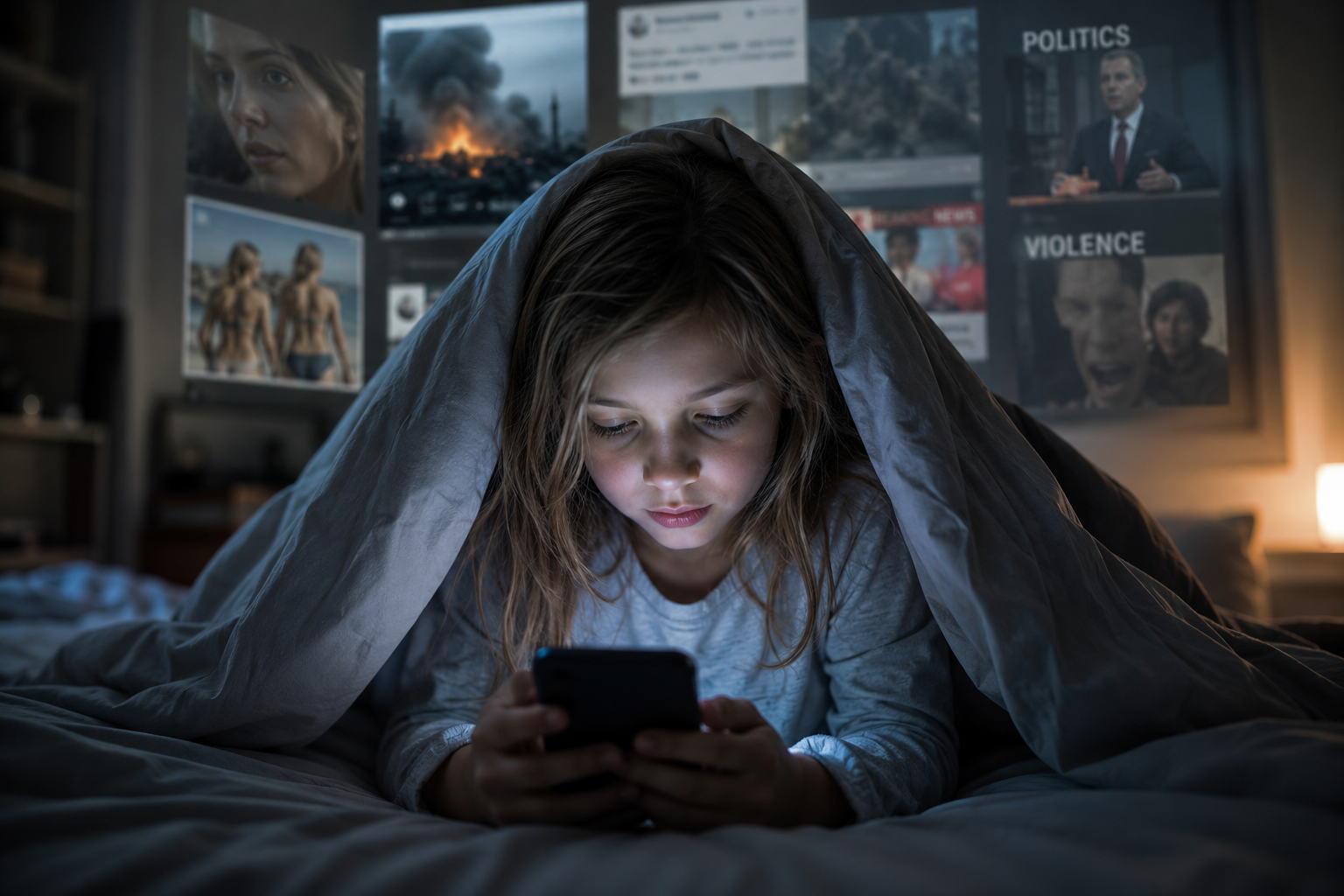
Children are exposed to adult conversations, adult fears, adult sexuality, adult outrage, adult politics, and adult anxieties earlier than ever before. At the exact same time, adults increasingly behave like emotionally reactive teenagers (why wouldn’t they? There’s no such thing as behavior to be ashamed about). We increasingly act as though the very idea of shame is abusive.
Someone suggesting that a person should feel shame over a behavior becomes a trauma. It’s a world that operates backwards.
Everybody performs while development withers like an overripe avocado left on the counter too long.
Social media did not create this problem, but it poured gasoline on it. Social media is a wonderful tool to enhance and reveal us as humans.
Adults publicly unravel online for validation from strangers.
Teenagers learn branding before identity.
Children learn performance before character.
Politics increasingly functions like reality television.
Even spirituality often feels more curated than formed.
The strange thing is that both sides of our cultural divide contribute to this in different ways.
Some people blame capitalism and corporations for commodifying childhood. They are not entirely wrong. Children are marketed to constantly. Attention itself has become the product.
Others blame moral decline, weak parenting, or the collapse of traditional values. They are not entirely wrong either. Boundaries matter. Formation matters. Parents matter.
But I think both sides often miss something important.
A healthy society requires adults who truly want to become adults.
That sounds obvious until you look around. What we’ve made enemy number one is “adulting.” A term I despise more than a rash in my armpit.
We increasingly celebrate perpetual adolescence. We celebrate impulsivity. We reward outrage. We monetize emotional reactivity. We treat self-control like repression and wisdom like boredom.
Our children absorb it all. They learn what we model.
One of the great ironies of modern life is that we have access to more information than any generation in human history while simultaneously struggling to produce emotionally grounded, resilient, mature human beings.
Information doesn’t form us. Knowledge doesn’t automatically produce wisdom.
In some ways, endless exposure may weaken wisdom because wisdom often requires slowness. Reflection.
Silence.
Restraint.
Time.
Most of us no longer live in environments designed for any of those things.
That’s the part that feels most important to me. I don’t think what we are losing is merely innocence.
I think we are losing wonder.
Not childishness.
Wonder.
There’s a difference.
Childishness is self-centered impulsivity. Maturity, or becoming an adult as the concept of adulthood is the shedding of the same.
Wonder is the ability to encounter life with depth, awe, humility, and curiosity.
Modern culture is remarkably good at stimulation.
It is increasingly terrible at real growth..
We distract ourselves endlessly.
We entertain ourselves constantly.
We perform ourselves publicly.
But many of us never slow down long enough to become anyone. Becoming someone would require responsibility.
It would require us to become adults and have a clear distinction between childhood and adulthood.
Maybe that’s why so many people feel exhausted right now. You’ll often hear people say that they’re exhausted because life is so busy.
But who keeps asking modern life to give us something to consume while asking nothing of us in return, allowing us to avoid responsibility that naturally comes with consumption?
In the book, Postman mentions that at some point in history kids became society’s preferred “objects of conspicuous consumption.” (Chapter 3, pp. 44).
Maybe that’s the greatest tragedy in all of this.
In our refusal to become adults, we’ve stolen childhood from our children.
Sure, we entertain them. We buy them things. We have them play sports.
But maybe in our obliteration of shame, reading and education, we’ve made those things more about us and the kids are just the objects we use to show off.
Proper shame is the result of having a clear line between childhood and adulthood. It’s the result of admitting there are topics, acts and even points of view that aren’t appropriate for children.
And maybe that’s why books like Postman’s still matter.
Not because they make us nostalgic for some perfect past that never really existed.
But because they force us to ask a harder question:
Who or what are we focusing on now? How is that focus shaping who we are becoming?
Most of all, his book (written before the modern social whipping dogs of social media and personal cell phones existed) might force us to consider do we even notice it happening.
Sign up here.